The England Family in the 1861 Census

Aug 26, 2022 | Archive

The Challenge

Kingston University design student Benny approached Maybrey Precision Castings with an innovative aluminium door handle concept that formed part of his final-year project. Having already produced a 3D printed prototype complete with the appropriate draft angles for sand casting, the initial objective was to manufacture a sample casting to validate the design.

Following the successful sample, Benny wanted to progress to a production-ready solution. As a student working within a limited budget, commissioning a professionally manufactured pattern was not financially viable, so he made the decision to manufacture the pattern himself at the Kingston University workshop.

To achieve a fully functional casting, the door handle required a hollow section at one end to accommodate the fixing mechanism. This introduced an additional level of complexity, requiring not only a pattern but also a correctly designed core box and core print arrangement to produce and accurately locate the sand core within the mould.

Our Solution

Working closely with Benny throughout the project, our technical team provided guidance at every stage of the tooling design process. Through a series of video calls, we discussed the complete pattern design, including impression layout, moulding box size, pattern orientation and the overall setup required for successful production.

Particular attention was given to the design of the core box and core prints. We explained how the positive core print on the pattern and the corresponding negative feature within the core box would accurately locate the sand core during mould assembly, ensuring the finished casting incorporated the required hollow section.

Using this guidance, Benny produced the complete pattern and core box design in CAD before submitting it to Maybrey Precision Castings for technical review and approval. Once approved, the tooling was manufactured at the Kingston University workshop.

Collaboration and Delivery

With the tooling complete, Benny visited our foundry in Aylesford, where he experienced the complete sand-casting process first-hand. Working alongside our experienced foundry team, he was shown each stage of production, from mould preparation and pattern setup through to core placement, aluminium melt preparation and the pouring of the moulds.

This collaborative approach enabled Benny to see how design decisions made during the development phase directly influenced the manufacturing process, providing valuable practical experience that cannot be gained in a classroom environment alone.

The Result

The finished aluminium castings met the design requirements and demonstrated a successful transition from concept, through tooling design, to completed cast components.

Benny was delighted with the finished door handles, which were exhibited at Kingston University's end-of-year showcase. The quality of his project led to his selection to exhibit at the prestigious New Designers Show in London, where emerging designers from across the UK present their work to industry professionals.

This project demonstrates Maybrey Precision Castings' commitment to supporting innovation and developing the next generation of engineers and product designers. By sharing our technical expertise and working collaboratively throughout the design and manufacturing process, we helped transform a student's concept into a professionally manufactured product ready for national exhibition.

Whether restoring history, supporting innovation or creating something entirely new, Maybrey Precision Castings combines traditional foundry craftsmanship with modern engineering expertise to turn ambitious ideas into exceptional castings.

Primary research by Grahame Hood.

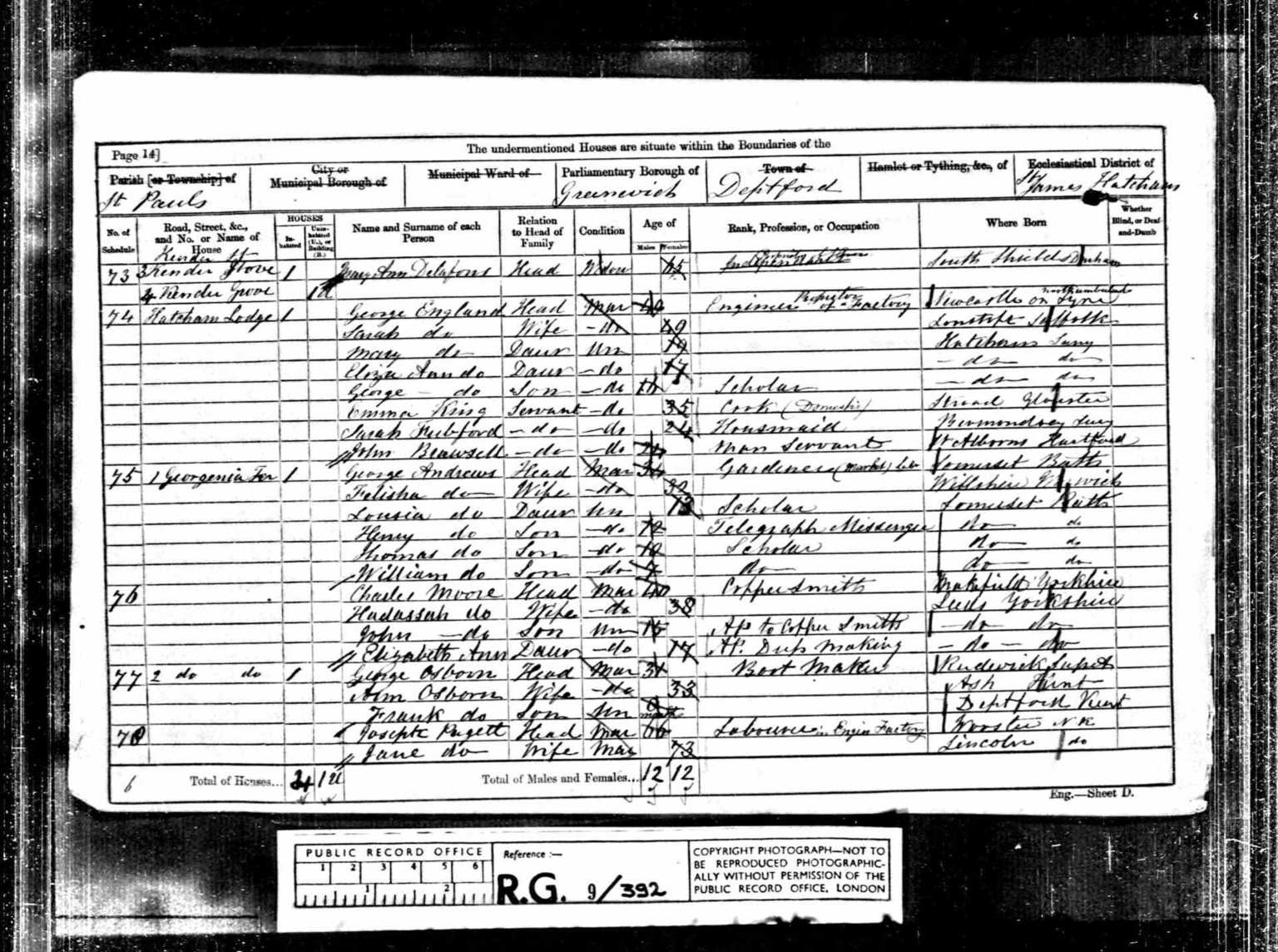
By the time the 1861 census took place, both Hatcham Lodge and Georgina Terrace had been in use for three years. The page transcribed here shows the inhabitants of Hatcham Lodge and Nos. 75-78 Georgina Terrace. They are handwritten and sometimes difficult to decipher.

74 Kender Street: Hatcham Lodge

George England is head of the family, Married, 49 years old, Engineer and Proprietor of Factory, born in Newcastle-upon-Tyne, Northumberland.

Sarah England is his wife, 49 years old, born in Lowestoft, Suffolk.

They have three unmarried children: Mary, 19; Eliza Ann, 17; and George, 16. George is listed as Scholar, though in fact he had been apprenticed to his father's firm since at least 1858. All children are recorded as born in Hatcham, Surrey.

There are three servants, all unmarried: Emma King, Cook (Domestic), 35, born in Stroud, Gloucestershire; Sarah Hubford, Housemaid, 24, born in Bermondsey, London; and John Blewsell (?), Man Servant, 24, place of birth illegible.

75 Kender Street: 1 Georgina Terrace

Occupied by George Andrews, a market gardener, his wife and five children. One child, a boy of 12, is listed as a Telegraph Messenger.

76 Kender Street: 2 Georgina Terrace

Occupied by Charles Moore, a coppersmith originally from Wakefield, Yorkshire, his wife, and two children. The son John is 17 and an apprentice coppersmith; the daughter Elizabeth Ann, also 17, is described as an apprentice dress maker (?).

77 Kender Street: 3 Georgina Terrace

The home of George Osborn, a boot maker, his wife, and son.

78 Kender Street

Occupied by Joseph Pugett and his wife Jane, aged 66 and 73 respectively. He is listed as Labourer in Engine Factory.

Commentary

Though England is supposed to have built the houses in Georgina Terrace for the benefit of his workers, they do not always seem to have been occupied by men in his employ. Of the four households recorded here, only Joseph Pugett at No. 78 is clearly employed at the works.
Maybrey Achieves Future Net Zero Platinum Award

Maybrey Precision Castings, as part of the Caro Group, has been awarded the Future Net Zero Platinum Award: the highest level of the FNZ programme and the most rigorous independent certification available for carbon reduction in UK manufacturing. The Platinum award...

read more...

We can take your casting through to finished component: machined, coated, tested, and ready to fit.