Primary research by Grahame Hood.
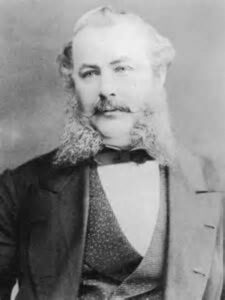
Robert Francis Fairlie was born in March 1831, of an engineering family.
Training and early career
“Crewe and Swindon gave him his training as a locomotive engineer, to such effect that he was appointed at 22 to superintend and manage the Londonderry and Coleraine Railway, though he went shortly afterwards to India to the Bombay and Baroda Railway. Later (in 1859) he became established as a consulting engineer at 56 Gracechurch Street, London EC.”
-
- Seymour, The Year of the Fairlie, Railway Magazine, September 1969, p.490 onwards.
The Fairlie patent
It was during this period that the idea for his patent germinated. Patent No. 1210, for improvements in locomotive engines and boilers, was granted on 12th May 1864. It covered the attainment of high tractive effort for low axle-loading, with flexibility of wheel-base. The adoption of total adhesion was to increase the grip on the rails. The boiler was to be mounted on the centres of two frames resting on the bogies.
A less well-known aspect of the patent was the provision of a second or even third layer of tubes in the boiler, reversing the gas flow to provide extra heating and drying of the steam before it passed to the cylinders.
In the same year Fairlie published a pamphlet, Locomotive Engines: What They Are and What They Ought to Be, in which he expounded, by means of a dialogue between an engineer and a writer, the current shortcomings of conventional steam engines. These included the wasteful need to carry a tender for fuel and water, the inadequacy of conventional tank engines for long runs, and the lack of standardisation. He then showed how his patent locomotive would overcome all these objections through superior steam generating, the all-adhesion principle, the ability to traverse sharp curves with reduced friction, and the abolition of turntables.
It has been said that Fairlie's idea was not original, since one of the competitors in the Semmering trials of 1851 was the Seraing, by the Belgian firm of Cockerill, which had all the features of the developed Fairlie locomotive. But the Seraing did not initiate a trend, whereas Fairlie developed his patent into engines built and sold all over the world.
A second patent, No. 3185 of 9th December 1865, proposed a modified engine with the fuel and water carried on the same chassis as the boiler and cab, but with only one boiler.
-
- Seymour, The Year of the Fairlie, Railway Magazine, September 1969, p.490 onwards.
At Hatcham and the elopement
By 1861, Fairlie was a frequent visitor to Hatcham Lodge. In January 1862 he eloped with George England's daughter Eliza Anne, having signed an affidavit claiming he had her father's permission to marry. England sued Fairlie for perjury. The case at the Central Criminal Court was widely reported: England was forced to admit under cross-examination that Eliza had been born out of wedlock and had no legal relationship to him. There was no case to answer and a not guilty verdict was returned. The families were eventually reconciled and Fairlie became involved in England's work. For the full account, see the archive article on George England.
Little Wonder and the Festiniog Railway
In 1868, the narrow gauge Festiniog Railway decided to trial the Fairlie design. England built the locomotive Little Wonder (Works No. not recorded), an 0-4-4-0T with outside cylinders of 8.25 by 13 inches and driving wheels of 2 feet 4 inches on 1 foot 11.5 inch gauge. This was a great success and was demonstrated to engineers from all over the world.
The Fairlie Engine and Steam Carriage Company
With George England Junior, Fairlie took over Hatcham as The Fairlie Engine and Steam Carriage Company, to build locomotives to his design and his patent steam carriage. George Junior's early death, and a lack of orders, led Fairlie to close the works. Apart from the steam carriage and Little Wonder, only four locomotives were produced under the new company name. Hatcham was sold in 1872.
Fairlie then formed The Fairlie Engine and Rolling Stock Company, to work as a consulting engineer and grant licences for locomotives to be built under his patent by other makers. More than 330 patent locomotives were built and exported to 21 countries in every continent with railways.
In 1873 Fairlie went to Venezuela to survey a new line. He contracted sunstroke, a fever, and blood poisoning there and never fully recovered, though he continued to work, travel, and carry out his business.
Robert Francis Fairlie died on 31st July 1885. He was 54 years old.
Fairlie's grave: West Norwood Cemetery
Field visit by Grahame Hood, 8th July 2014.
Robert Fairlie is buried in West Norwood Cemetery. The grave is number 20788, in square 22, a little back from the path.
The register in the cemetery office shows that the plot cost £26 5s and contains:
Robert Francis Fairlie (buried 1885)
John Simpson Fraser (1891)
Mary Fraser (1906)
Elizabeth A. Fairlie (1907)
The gravestone is nearly six feet tall and bears the following inscriptions:
“Robert Francis Fairlie. Who died July 31st 1885. Aged 54 years.”
“Also of Lily his wife. Who died April 15th 1907. Aged 63 years.”
“John Simpson Fraser. Brother-in-law to the above. Died July 18th 1891. Aged 69 years.”
“And of Mary, his wife. Who died May 11th 1906. Aged 84 years.”
John Fraser was Fairlie's partner in the takeover of Hatcham along with George England Junior. Fraser was born 1822, as was Mary his wife. Mary was presumably Fairlie's older sister.