The Artist and the Design Process

Dec 5, 2024 | Know-How

The Challenge

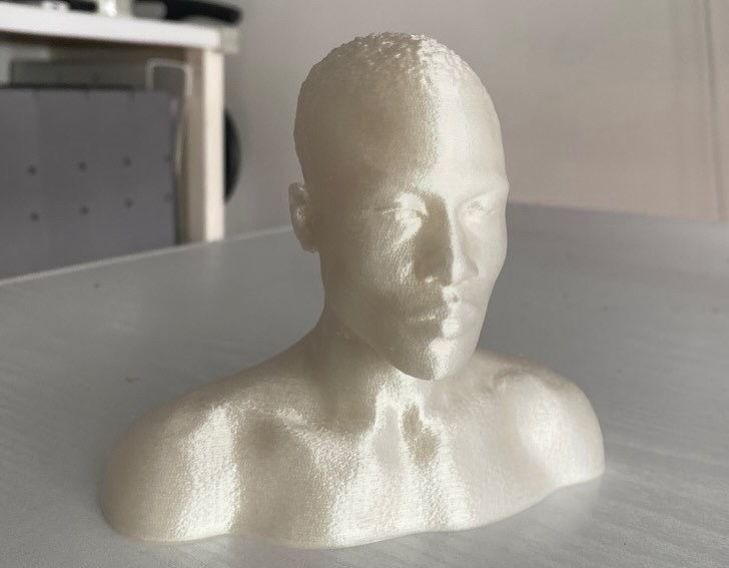
Kingston University design student Benny approached Maybrey Precision Castings with an innovative aluminium door handle concept that formed part of his final-year project. Having already produced a 3D printed prototype complete with the appropriate draft angles for sand casting, the initial objective was to manufacture a sample casting to validate the design.

Following the successful sample, Benny wanted to progress to a production-ready solution. As a student working within a limited budget, commissioning a professionally manufactured pattern was not financially viable, so he made the decision to manufacture the pattern himself at the Kingston University workshop.

To achieve a fully functional casting, the door handle required a hollow section at one end to accommodate the fixing mechanism. This introduced an additional level of complexity, requiring not only a pattern but also a correctly designed core box and core print arrangement to produce and accurately locate the sand core within the mould.

Our Solution

Working closely with Benny throughout the project, our technical team provided guidance at every stage of the tooling design process. Through a series of video calls, we discussed the complete pattern design, including impression layout, moulding box size, pattern orientation and the overall setup required for successful production.

Particular attention was given to the design of the core box and core prints. We explained how the positive core print on the pattern and the corresponding negative feature within the core box would accurately locate the sand core during mould assembly, ensuring the finished casting incorporated the required hollow section.

Using this guidance, Benny produced the complete pattern and core box design in CAD before submitting it to Maybrey Precision Castings for technical review and approval. Once approved, the tooling was manufactured at the Kingston University workshop.

Collaboration and Delivery

With the tooling complete, Benny visited our foundry in Aylesford, where he experienced the complete sand-casting process first-hand. Working alongside our experienced foundry team, he was shown each stage of production, from mould preparation and pattern setup through to core placement, aluminium melt preparation and the pouring of the moulds.

This collaborative approach enabled Benny to see how design decisions made during the development phase directly influenced the manufacturing process, providing valuable practical experience that cannot be gained in a classroom environment alone.

The Result

The finished aluminium castings met the design requirements and demonstrated a successful transition from concept, through tooling design, to completed cast components.

Benny was delighted with the finished door handles, which were exhibited at Kingston University's end-of-year showcase. The quality of his project led to his selection to exhibit at the prestigious New Designers Show in London, where emerging designers from across the UK present their work to industry professionals.

This project demonstrates Maybrey Precision Castings' commitment to supporting innovation and developing the next generation of engineers and product designers. By sharing our technical expertise and working collaboratively throughout the design and manufacturing process, we helped transform a student's concept into a professionally manufactured product ready for national exhibition.

Whether restoring history, supporting innovation or creating something entirely new, Maybrey Precision Castings combines traditional foundry craftsmanship with modern engineering expertise to turn ambitious ideas into exceptional castings.

The Black Renaissance sculptures began not in a foundry, but in the intersection between history, digital technology, and one artist's determination to represent the unrepresented.

Rayvenn Shaleigha D'Clark

Rayvenn Shaleigha D'Clark is a British sculptor whose practice combines digital and traditional methods. Her work is concerned with representation, identity, and the public landscape: who gets to be depicted in permanent material, and what that tells us about whose stories a society considers worth preserving.

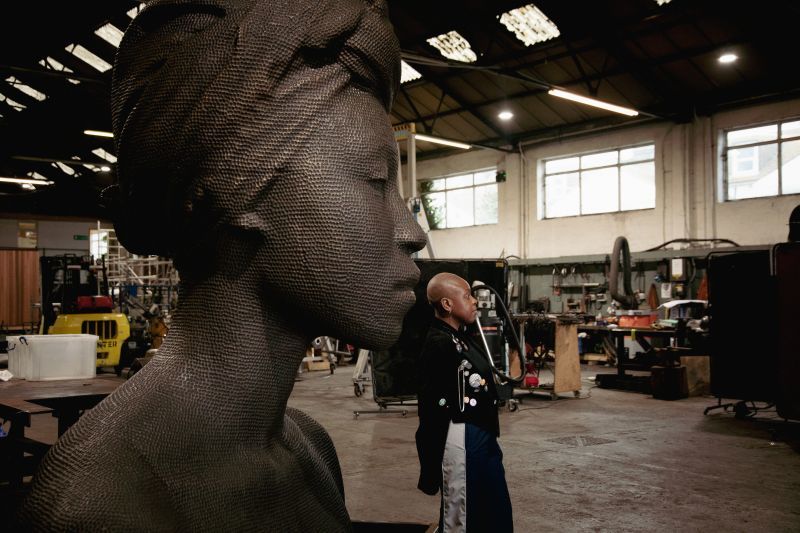
For the Black Renaissance commission, D'Clark was given the brief to create five monumental figures representing anonymous individuals whose histories are part of the story the Freedom Monument Sculpture Park tells. She brought to the commission a process that is both technically sophisticated and deeply human.

From Research to Digital Model

D'Clark's starting point was research: into the lives, the culture, and the visual language of the communities the sculptures would represent. From that research, she developed digital models using professional sculpting software, working at a level of surface detail that was extraordinarily demanding.

The surfaces of the Black Renaissance sculptures carry fine physiological and cultural detail: features, textures, and references that had to be present in the final bronze for the work to be what it needed to be. Some of this detail pushed the software to its limits. Where the digital tools could not fully resolve what D'Clark needed, physical intervention, sketching, and dialogue between the artist and our casting team filled the gap.

The Foundry Conversation

What made this project work was not just the technology. It was the conversation between the artist and the foundry. D'Clark understood that a casting has its own constraints: minimum wall thicknesses, draft angles, the way metal flows and solidifies. Our team understood that a work of art has its own non-negotiable requirements.

The result of that conversation was a casting approach that used 3D printed sand moulds produced directly from D'Clark's digital files. This allowed us to preserve the surface detail that the artist had worked to create, without the compromise that conventional pattern tooling would have forced.

52 Unique Castings

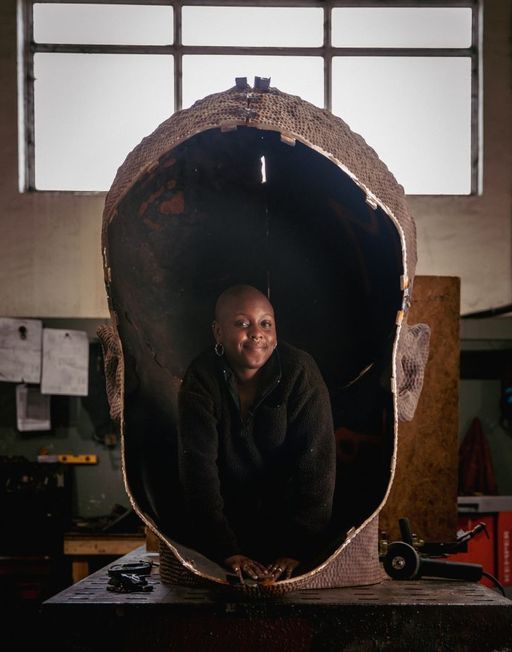
Each of the five sculptures was cast in multiple segments: 52 unique castings in total, each from its own 3D printed mould. No two moulds were identical. The assembly of those segments into the finished sculptures was carried out by Millimetre, West Sussex, whose fabrication skill was as important to the final result as the casting.

Seeing the completed sculptures installed at the Freedom Monument Sculpture Park is, for everyone who worked on this project, a reminder of what the trade of casting is capable of when it is placed in service of something worth making.
Read the technical case study

Instagram: @rayvenndclark_art

Maybrey Achieves Future Net Zero Platinum Award

Maybrey Precision Castings, as part of the Caro Group, has been awarded the Future Net Zero Platinum Award: the highest level of the FNZ programme and the most rigorous independent certification available for carbon reduction in UK manufacturing. The Platinum award...

read more...

We can take your casting through to finished component: machined, coated, tested, and ready to fit.