This list was initially based on the one published in J.W. Lowe's British Steam Locomotive Builders. I am certain there were some errors and also that more locomotives were built than have been recorded. I have added as much new information as I can from such sources as I can find. I have not repeated any information from new sources that agrees with previously known information, but have provided alternative information where it may possibly be correct.
There are many errors that appeared in print, particularly in the early railway press. For example, that the cancellation of the 1852 order for locomotives to Russia ruined the company, or that Scott was the locomotive that appeared at the 1862 Great Exhibition. I would be delighted to receive further information on any aspect of the Hatcham Ironworks output.
Format: Year / Works No. / Wheel arrangement / Cylinders / Driving wheel / Gauge / Operator / Name or number
1843
Manumotive Railway Carriage
"A machine of this description is in use upon the London and Croydon Railway, having been lately made for Mr Gregory, the Resident Engineer, by Mr George England, Engineer. The machine is very light and elegant in appearance, and is capable of carrying seven or eight persons at a rate of 18 miles per hour."
1848/1849
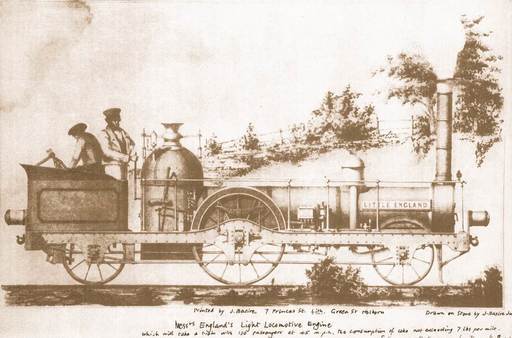
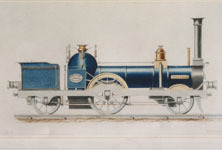
Works no. n/k / 2-2-2WT / Inside cylinders 7" × 12" (later 9" × 12") / Driving wheel 4ft 6in / Standard gauge / London and Brighton Railway / Little England
In November 1848, the Mining Journal reported England's first locomotive experiments in considerable detail. Trials took place between New Cross and Croydon. From February 1st 1849, Little England began working the Lynn and Wisbech branch of the East Anglia Railway. It is likely she soon returned to the works for modification, including fitting of 9 by 12 inch cylinders, removal of name, and sale.
The Railway Times, 2nd and 9th December 1848; The Morning Herald, 11th December 1848; The Railway Times, 3rd March 1849.
1849
- Works no. ? / 2-2-2WT / Inside cylinders 9" × 12" / Driving wheel 4ft 6in / Standard gauge / Dundee, Perth and Aberdeen Junction Railway / Eclipse
C.H. Dickson, SLS Journal, 1962, p.207.
- Works no. ? / 2-2-2WT / Inside cylinders 9" × 12" / Driving wheel 4ft 6in / Standard gauge / London and Blackwall Railway / Dwarf
Delivered September 1849. Price £1,000. Resold to makers August 1851 for £700 against two new engines (Samson and Hercules of 1852).
C.H. Dickson, SLS Journal, 1962, p.207; E. Craven, SLS Journal, 1955, p.306.
1850
- Works no. ? / 2-2-2WT / Inside cylinders 9" × 12" / Driving wheel 4ft 6in / Standard gauge / London and Blackwall Railway / Pigmy Giant
Delivered January 1850. Price £950. Resold to makers August 1851 for £700 against two new engines (Samson and Hercules of 1852). As they were sold back on part exchange it is possible they stayed on the L&B until the new engines were delivered and did not actually return to the makers until 1852, though this is speculation.
C.H. Dickson, SLS Journal, 1962, p.207; E. Craven, SLS Journal, 1955, p.306.
- Works no. ? / 2-2-2WT / Inside cylinders 9" × 12" / Driving wheel 4ft 6in / Standard gauge / Edinburgh and Glasgow Railway / England (also referred to as Little Scotland or Wee Scotland; see Addendum)
England and Co. guaranteed these light engines to haul trains of six carriages at a speed of 40 miles per hour on gradients of 1 in 100, at a coke consumption of only 10lb. per mile. The engine frequently ran in before its time and the driver had to be ordered to take longer on the trips for fear of an accident. During the heavy winds and gales of January 1851, the Little England was the only locomotive on the line that kept time.
Campbell Highet, Scottish Locomotive History 1831–1923, George Allen and Unwin, 1970, p.48; G.A. Sekon, Evolution of the Steam Locomotive, 1899, pp.142–143.
- Works no. ? / 2-2-2WT / Inside cylinders 9" × 12" / Driving wheel 4ft 6in / Standard gauge / Liverpool Crosby and Stockport Railway / England
Delivered September 1850. Price £1,200. This engine frequently drew ten carriages under the conditions laid down for seven.
G.A. Sekon, Evolution of the Steam Locomotive, 1899, pp.142–143; C.H. Dickson, SLS Journal, 1962, p.207.
- Works no. ? / 2-2-2WT / Inside cylinders 9" × 12" / Driving wheel 4ft 6in / Standard gauge / Exhibition engine / Little England (Gold Medal, Great Exhibition 1851)
C.H. Dickson, SLS Journal, 1962, p.207.
- Works no. ? / 2-2-2WT / Inside cylinders 9" × 12" / Driving wheel 4ft 6in / Standard gauge / Namur-Liege Railway / n/k
Probable delivery around 1851, based on a report in Herepath's Railway Journal for 1850, p.1229.
1852
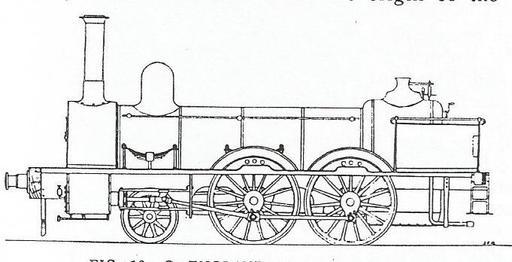
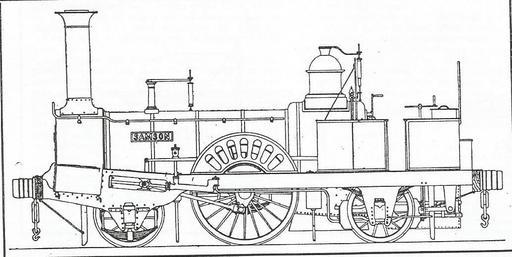
- Works no. ? / 2-2-2WT / Outside cylinders 15" × 18" / Driving wheel 5ft 6in / Standard gauge / London and Blackwall Railway / No. 8 Samson
Renumbered Great Eastern Railway 99 on takeover 1/1/66, renumbered 990 in 1878, scrapped October 1881. Cost £1,750. Built to the same design as Victoria, already working on the London and Blackwall.
A.R. Bennett, Locomotive Building in London, Railway Magazine, November 1907, pp.387–388; H.L. Hopwood, The London and Blackwall Railway, Railway Magazine, January–June 1927, pp.341–342; E. Craven, SLS Journal, 1955, p.306.
- Works no. ? / 2-2-2WT / Outside cylinders 15" × 18" / Driving wheel 5ft 6in / Standard gauge / London and Blackwall Railway / No. 9 Hercules
Renumbered Great Eastern Railway 100 on takeover 1/1/66. Out of service June 1866, scrapped April 1870.
- Works nos. ? / 2-4-0 / Outside cylinders 16" × 20" / Driving wheel 5ft 0in / Standard gauge / Caledonian Railway / Nos. 144–149
These locomotives are supposed to have been a cancelled order for Russia. Around this time Russian railways standardised to 5 foot gauge, and this, along with difficulty in paying for the order, probably led to the cancellation. The Caledonian bought them in 1854. Two others of this sort were bought in 1852 by the Scottish firm C. Dunlop and Co. and named Cuilhill and Monkland. They were sold to the Caledonian in 1857 and numbered 182 and 183.
The Locomotive, 15th May 1941, p.14; Industrial Locomotives of Scotland, ILS, 1976, p.95.
1853
- Works nos. ? / 2-4-0 / Outside cylinders 16" × 20" / Driving wheel 5ft 0in / Standard gauge / Caledonian Railway / Nos. 150–151
1852/3
- Works nos. ? / 2-4-0 / Outside cylinders 16" × 22" / Driving wheel 4ft 9in / Standard gauge / Dundee, Perth and Aberdeen Junction Railway / Nos. 13 Scorpion, 14 Spitfire, 15 Sprite
No. 15 was purchased in 1855, presumably being one left on the maker's hands by a cancelled order. The three engines passed to the Scottish Central Railway, Nos. 13 and 14 by sale in April 1860, No. 15 at the takeover in 1863.
C.H. Dickson, SLS Journal, 1961, p.209.
1854/5
- Works nos. ? / details n/k / Standard gauge / West Flanders Railway / Nos. n/k
C.H. Dickson, SLS Journal, 1961, p.209.
1855
- Works no. ? / details n/k / Standard gauge / Sambre et Meuse Railway
This engine ended up as No. 90 on the Grand Central Belge.
C.H. Dickson, SLS Journal, 1961, p.209.
Addenda
- Ophir: A locomotive named Ophir was purchased in March 1866 by Isaac Boulton at an auction in Grays Chalk Quarries, Essex. At the time it was a 2-2-0, with leading wheels of 2ft diameter and drivers of 5ft, with three inside cylinders, all 5 by 10 inches. Whether it originated at Hatcham is uncertain. C.H. Dickon considered that it being a Hatcham product does not seem likely.
- What happened to Pigmy Giant and the Exhibition locomotive? Multiple later sightings of engines named Little England have been recorded by various historians, but their exact identities remain uncertain.
- Wee Scotland: What was the locomotive supplied to the Edinburgh and Glasgow actually called? G.A. Sekon refers to Little England, Campbell Highet calls it Little Scotland, and Hamilton Ellis calls it Wee Scotland. There was a locomotive of that name but it was not an England locomotive. Surely Wee Scotland was a jocular riposte to Little England?